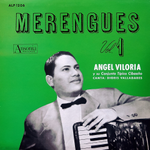
Merengues Vol. 1
1975 · Album · 12 tracks
Ángel Viloria y su Conjunto Típico Cibaeño was the first Dominican group to break merengue outside the country. It recorded in New York for barely three years in the early fifties and its reach outlived it by decades — as far as Haiti, where it helped bring a whole genre into being.
Ángel Viloria
Ángel Salvador Viloria was born in Santo Domingo on 1 June 1914, son of the accordionist Maximiliano Viloria and Belisa Pérez. He took up his father’s instrument and worked through the forties in the Dominican Republic as a pianist and director, with the Orquesta La Benefactora and, in 1947, the Orquesta Tropical, which belonged to Luis Rivera and played the Café Ariet in the capital. He and his family left for New York at the end of the decade.
Ansonia Records
In 1950 he met Rafael Pérez, the Puerto Rican who ran Ansonia Records, and Pérez pushed him to put a merengue típico group together and lead it. Between 1950 and 1952 the conjunto cut somewhere between thirty and forty merengues for the label, and a good number of them are still standard repertoire.
The line-up
Viloria led from the accordion. Dioris Valladares sang lead and played güira; Luis Quintero was on tambora; Ramón E. García and Ramón Quesada played saxophones, García on alto; Willy Osías played double bass; and Jaime Richetti sang and took the choruses.
Valladares carried the front of the group. He had not grown up with Cibao merengue and built a vocal style of his own out of that, and it became the sound people recognised. In the New York clubs he was paid what the bandleader was paid.
How típico it was
The name made a claim: típico, from the Cibao, where merengue began. The music only half kept it. The accordion was genuinely típico, and the tempo sat faster than the ballroom orchestras. But the brightness, the saxophones and the shape of the arrangements owed more to the urban, jazz-inflected merengue Luis Alberti had built in the forties than the billing let on.
They also took the accordion in directions the Cibao had not: piano-accordion voicings, phrasing borrowed from the bandoneón, and early adaptations of Colombian vallenato into merengue.
The Palladium and the reach
They were the first group of their kind signed to the Palladium, which was the centre of Latin music in New York through the fifties. The records travelled to Puerto Rico, Colombia, Venezuela and Honduras and back to the Dominican Republic; En la Oscuridad became the merengue Dominicans abroad asked for. In a room where the money was on mambo, guaracha and bolero, they got merengue onto the floor.
The end
The group had split by 1953, with Viloria, Quintero and Valladares each going off to lead their own. Viloria died on 26 August 1954, aged forty.
Legacy
Their influence reached furthest in a place they were not aiming at. In Haiti, the conjunto was a direct inspiration for the creation of konpa — a Dominican accordion band recorded in New York, feeding the invention of the national popular music next door.
At home the recognition never came. Seventy years on, neither Viloria nor Valladares has a street, a square or a hall named for him in the Dominican Republic.
1975 · Album · 12 tracks
1972 · Single · 2 tracks