Biography
Billo Frómeta, born Luis María Frómeta Pereira in Santo Domingo on 15 November 1915, was a Dominican musician, composer and bandleader who built his career in Venezuela, where he founded Billo's Caracas Boys, one of Latin America's most influential dance orchestras. He died in Caracas on 5 May 1988.
Origins in the Dominican Republic
Frómeta grew up in San Francisco de Macorís, where music was compulsory schooling and he studied theory and solfège under Sixto Brea, harmony and composition under Rafael Pimentel, and saxophone and clarinet under Oguis Negrette. At fifteen, in 1930, he founded and directed, with the rank of captain, the fire brigade's band in what was then Ciudad Trujillo, and he was a founding member of the Orquesta Sinfónica de Santo Domingo. He moved to the capital in 1933, giving guitar lessons and arranging for small groups; the saxophonist Freddy Coronado gave him work and encouraged him to form the Conjunto Tropical. Frómeta, Coronado, Francisco Damirón and Negrito Chapuseaux went on to found the Santo Domingo Jazz Band, first led by Damirón and, once Damirón moved to Puerto Rico, by Frómeta himself. He began studying medicine at the Universidad de Santo Domingo but left after his third year to devote himself fully to music.
The voyage to Venezuela
On 26 December 1937 Frómeta and his musicians sailed from the Río Ozama port on a ship called the Sordwagen, travelling in the coal hold on oranges, bread and cheese, and reached Caracas on 31 December to play the Roof Garden, the city's leading dance hall. Its owners, the Sabal brothers, renamed the orchestra Billo's Happy Boys; because the new name dropped any mention of Santo Domingo, it drew protest in the Dominican Republic, and under Trujillo's dictatorship, with the club's contract repeatedly renewed, the musicians ended up settling in Caracas rather than going home. In 1938 the orchestra appeared, singing «Taboga» with Negrito Chapuseaux on lead vocal, in Venezuela's first sound film, and began recording for RCA Victor; Frómeta also struck up a friendship with the Mexican composer Agustín Lara, who, barred by his own publishing contract from writing anything but romantic songs, wrote dance numbers for the band under assumed names. A severe case of typhus nearly killed him in 1939, and the orchestra briefly disbanded while he recovered.
Billo's Caracas Boys
In August 1940 Frómeta reorganized the group as Billo's Caracas Boys, named for the city that had become his home. Manolo Monterrey and Rafa Galindo were among its early singers, and the orchestra also backed touring soloists such as the tenor Alfredo Sadel. In 1946 he began hosting his own weekly radio hour, «A Gozar, Muchachos», and used the station's recording equipment to press his first records under the name Billo; he left RCA Victor in 1948 to release music on his own account. In 1955 he was among the founders of the Sociedad de Autores y Compositores de Venezuela. Under his baton the orchestra became known for the mosaico, a danceable medley threading together boleros, guarachas and merengues, and even as it absorbed Venezuelan joropo and Colombian cumbia it kept the merengue and mangulina of Frómeta's own country in its arrangements.
A ban and a comeback
In 1958, after the fall of the Pérez Jiménez dictatorship, Venezuela's musicians' association barred Frómeta for life from performing in the country. He spent the interruption in Cuba, recording with local musicians under his own name for the Venezuelan labels Sonus and Venevox, on sessions that featured the singer Alberto Beltrán among others. In May 1960 the association lifted the ban, judging it unjust, and Frómeta returned to Caracas to rebuild his orchestra, recruiting the singers Cheo García and Felipe Pirela in Maracaibo.
Later career
From 1963 he ran his own label, Fonograma, which recorded both his orchestra and new artists; José Luis Rodríguez "El Puma" was among the singers who passed through the band in these years. The Fonograma catalogue was later carried on as Sonograma.
The Guinness record and death
In 1987 Billo's Caracas Boys played an open-air concert in the Plaza de España in Santa Cruz de Tenerife, with Celia Cruz sitting in for her only performance with the orchestra; the 250,000-strong crowd earned the show a Guinness World Record for attendance at an outdoor dance. On 27 April 1988, at the end of a rehearsal of «Un Cubano en Caracas» for a concert planned to mark his fiftieth year in Venezuelan music, Frómeta collapsed, apparently from a cerebral hemorrhage, after his musicians gave him a standing ovation; he never regained consciousness and died on 5 May 1988. His coffin was carried on a fire engine, in tribute to the fire brigade band he had led as a teenager, in a procession that ran more than twenty kilometers to the Cementerio del Este in Caracas.
Legacy
Billo Frómeta left Santo Domingo as a young bandleader copying the fashionable orchestras of Puerto Rico and Cuba and became, over half a century in Venezuela, the architect of that country's modern dance-orchestra sound and the mosaico format still heard at Latin American parties. Generations of Venezuelan and Caribbean singers passed through Billo's Caracas Boys, which continues to perform as an institution decades after his death, and Dominican listeners still hear, in an orchestra built to please Caracas, the merengue and mangulina Frómeta carried with him from San Francisco de Macorís.
Interviews & Documentaries
Interviews, conversations, and archival media connected to this artist.
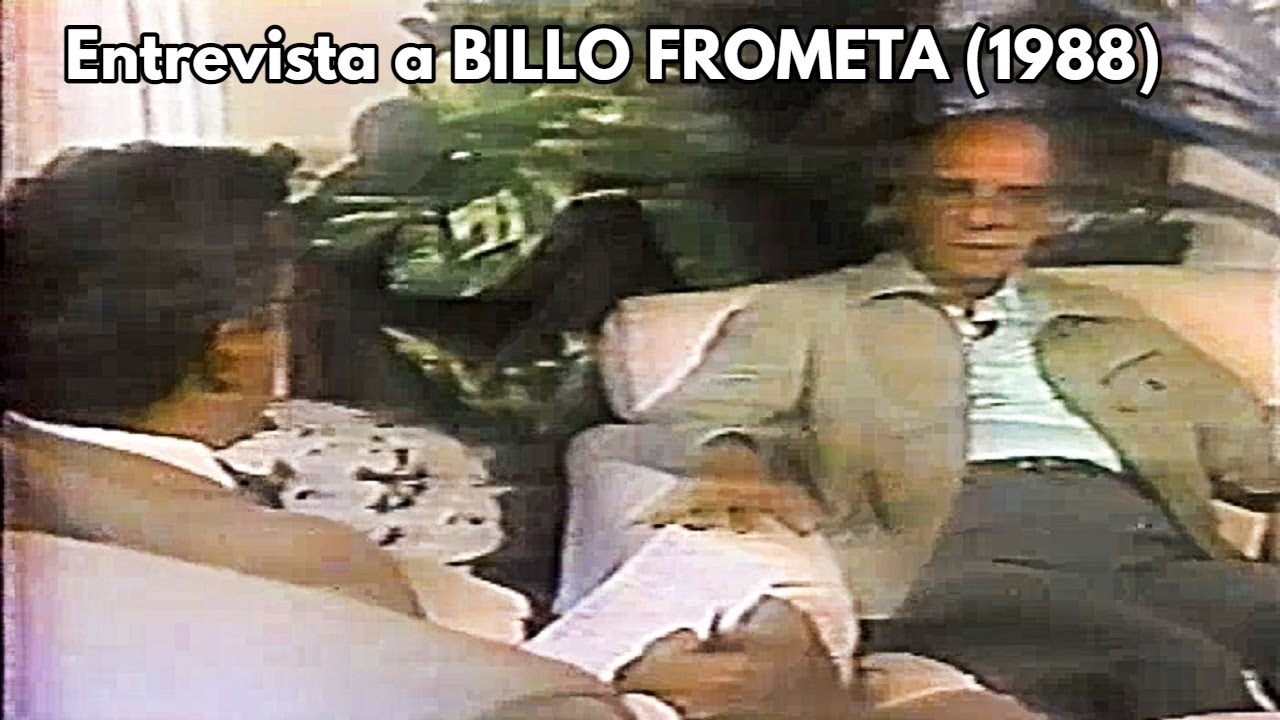
Entrevista a BILLO FROMETA (1988)

October 06, 2022

A gozar con Billo

October 24, 2017