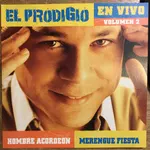
En vivo
1999 · Album · 13 tracks
El Prodigio — Cresencio García, born in Media Gorra de Cabrera on 14 November 1976 — is a Dominican merengue típico accordionist, bandleader and film composer. He is the player who took the button accordion out of the dance circuit and into jazz, and he has more Casandra statuettes than any other típico artist of his generation.
Early years and formation
He was the third son of Luis García, an accordionist, and Benita Mata, a nursing assistant. He gave his first public performance at five, which is where the stage name comes from — he was a prodigy in the plain sense, a small child who could already play. The music press has always written him as Krency, and it stuck; both forms are his.
The accordion and the jazz
What separates him from his contemporaries is speed with intent. The solos are fast enough to be a party trick and are not one: he improvises inside the harmony rather than over it, which is what studying jazz at Berklee gave him.
He also widened the band. Alongside the accordion, tambora, güira, conga, bass and saxophones that a modern típico conjunto carries, he has put trombone, trumpet and wurlitzer on stage. Where Tatico Henríquez and Francisco Ulloa worked the form from inside its own instrumentation, El Prodigio kept adding to it.
The records
He has led El Prodigio y la Mezcla Típica and El Prodigio y La Banda Típica. El Quita Pena, in 2012, he made with Juan Luis Guerra 4.40. In 2015 he recorded Homenaje al Ciego de Nagua, turning a full album over to El Cieguito de Nagua.
Scoring for film
He wrote the score for Boca Chica, Gabriella A. Moses’s first feature, which played in the International Narrative Competition at the Tribeca Festival in 2023 and won Moses the Nora Ephron Award. It is a Dominican film about a twelve-year-old girl in a coastal town, written by Mariana Rondón and Marité Ugas.
He had scored the short Un Jedi Quedao’ en Tatooine in 2015, and worked in the music department of the television series ¡Que Viva el Merengue! in 2005. A típico accordionist writing for the screen is rare; the instrument is not usually asked to carry a narrative.
Recognition
Seven Casandra awards — now the Soberano — had come to him by 2014, more than típico had given any single artist since the category existed. His long-running rivalries with Geovanny Polanco and Kerube Ortiz, both more traditional players, are part of how the genre has argued with itself about how far it should move.
1999 · Album · 13 tracks
2003 · Album · 11 tracks
2004 · Album · 10 tracks

2020 · Single · 1 track
2024 · Single · 1 track